The guide
Polish wedding traditions,
explained for
international guests.
Invited to a Polish wedding? Marrying into a Polish family? Here is what actually happens — the traditions, the timeline, the food, the vodka, and why the last song plays at 4 a.m. Written by a wedding MC who has run over 400 of these evenings.
First things first
A Polish wedding is not
an evening event.
It’s an all-night one.
The reception — the wesele — usually starts in the late afternoon and ends around 4 in the morning: about ten hours from the moment the couple enters the venue. Hot meals keep arriving every couple of hours. Between them, everyone dances. Not a polite shuffle near the bar: grandmothers, teenagers, the groom’s boss — the whole room.
This rhythm surprises most foreign guests, and it’s also the thing they remember years later. Polish weddings are built on a simple idea: the couple invited you, so the couple’s job — and their team’s job — is to make sure you eat well, feel welcome, and never sit wondering what happens next.
Holding those ten hours together is a dedicated role: the wodzirej, a bilingual master of ceremonies at international weddings. If the word is new to you, there’s a whole page explaining what a wodzirej does.
At a glance
| What | Expect |
|---|---|
| Length | Around ten hours, into the night |
| Hot meals | Three to five, served into the small hours |
| Ends | Around 4 a.m. |
| Day two | Poprawiny — the follow-up party |
| Your shoes | Choose the comfortable ones. Trust us. |
The traditions
Six things you’ll see — and what they mean
Every region and every family does it slightly differently, but these are the moments almost every Polish wedding shares.
🍞
Bread and salt
On arrival at the venue, the parents greet the newlyweds with bread and salt — bread for abundance, so the couple never goes hungry; salt for wealth and, in the old belief, protection against evil. A short toast follows, and at many weddings the glasses are thrown over the shoulder for luck.
🎶
Sto lat
The song you will hear ten times before midnight. Sto lat means “a hundred years” — may the couple live that long. When it starts, stand up, raise whatever is in your glass, and hum along. You’ll know the melody by the second course.
💃
The first dance
Polish couples take this seriously — many spend months in dance lessons before the wedding. The floor stays empty until the newlyweds open it. After that, it rarely empties again until morning.
👑
Oczepiny
The midnight ceremony. Historically the bride’s veil was exchanged for a cap, marking her first night as a married woman. Today it usually means the veil toss, its bow-tie equivalent for the groom, and a round of games for the guests.
🎮
Wedding games
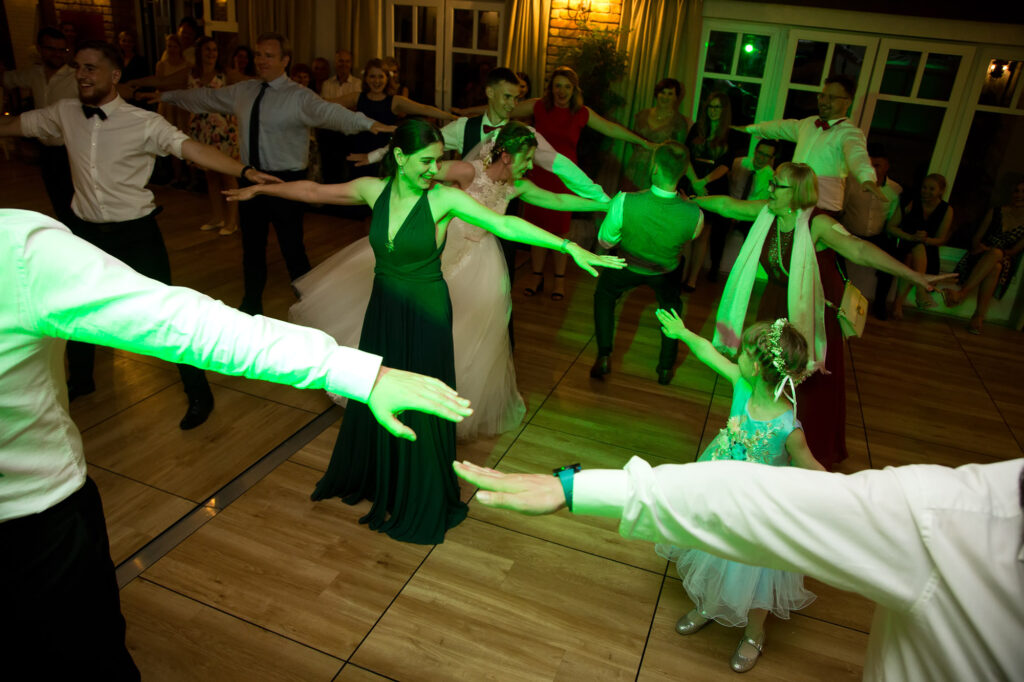
Led by the wodzirej between courses — team games, dance-offs, the wężyk (a long chain of dancers snaking through the whole venue). Done well, they’re voluntary and genuinely funny. Nobody gets dragged onto the floor, and watching from your seat is a perfectly respectable sport.
🍴
Poprawiny
The day-two party, usually at the same venue from early afternoon. Smaller, slower, more comfortable shoes. Leftover cake, more hot food, and everyone’s favourite stories from the night before.
The timeline
The wedding day, hour by hour
Times shift from wedding to wedding, but the shape of the day is remarkably consistent.
3:00 PM
The ceremony
Church or civil. If it’s Catholic, expect around an hour. Polish couples wear their rings on the right hand — don’t let it confuse you at dinner. As the newlyweds step out of the church or registry office, guests shower them with rice or coins for luck.
5:00 PM
Welcome at the venue
Bread and salt from the parents, then a champagne toast. Guests are greeted personally — nobody stands in a corner holding their coat.
5:30 PM
First course
Almost always rosół — golden chicken broth with noodles. The first of many plates. Pace yourself; this is a marathon, not a sprint.
7:00 PM
First dance
The couple opens the floor, the band or DJ takes over, and the evening properly begins.
9:00 PM
Courses, toasts, games
Hot food keeps coming roughly every two hours. Between courses: dancing, toasts, and games led by the wodzirej. This cycle — eat, dance, laugh, repeat — is the engine of the whole night.
12:00 AM
Oczepiny
The midnight ritual: veil toss, games, and a symbolic handover from wedding formality to pure party. If you were planning to slip out early — this is the part people talk about for years. Stay.
1:00 AM
The late-night course
Often barszcz (beetroot soup) or bigos — hot, restorative, exactly what a dance floor full of people needs at 1 a.m.
4:00 AM
The last song
The official end. The wężyk may still be winding through the corridor. Tomorrow: poprawiny.
Guest questions
What foreign guests actually ask
What do I give as a wedding gift?
Most often money, in a card, handed to the couple during the welcome line. If you’d rather give a physical gift, ask the best man or maid of honour — they usually keep the couple’s wish list. Some couples also publish a gift list on their own wedding website (couples who book Karol get one, list included, free of charge). Flowers are optional, and many couples now ask for none.
Do I have to drink vodka?
No. Bottles appear on every table and toasts happen often, but raising a glass of juice counts exactly the same. At a well-run wedding nobody pressures anyone to drink — at weddings Karol leads, that’s an iron rule, not a courtesy.
What should I wear?
A suit or a cocktail dress is right at nearly every Polish wedding — but plan for ten hours of it. Jackets come off around the third course. Avoid white, and bring shoes you can dance in, because you will.
Will I understand anything if I don’t speak Polish?
At a traditional wedding, honestly — not much. That’s exactly why bilingual weddings have an English-speaking MC: every announcement, toast and game lands in both languages, so you’re part of the evening, not an observer of it. Here’s how that works in practice.
Can I leave before the end?
You can — but try to stay past oczepiny at midnight. Leaving before it is the Polish equivalent of walking out of a film twenty minutes before the ending. Say goodbye to the couple on your way out; they genuinely want to know you were there.
Is it rude to sit out the games?
Not at all. Good wedding games run on volunteers, and an audience that’s laughing is contributing just as much. If an MC ever tries to force you into one, he’s doing his job badly.
Planning a Polish-international wedding?
The first conversation is two hours, no commitment,
and completely free.