
How it works
You’ve never heard
of a wodzirej.
That’s fine.
Most international couples haven’t. This page explains what Karol does, why Polish receptions run the way they do, and what happens at each stage, from the first call to the last dance.
The role explained
A wodzirej is not a DJ,
and not a toastmaster
either.
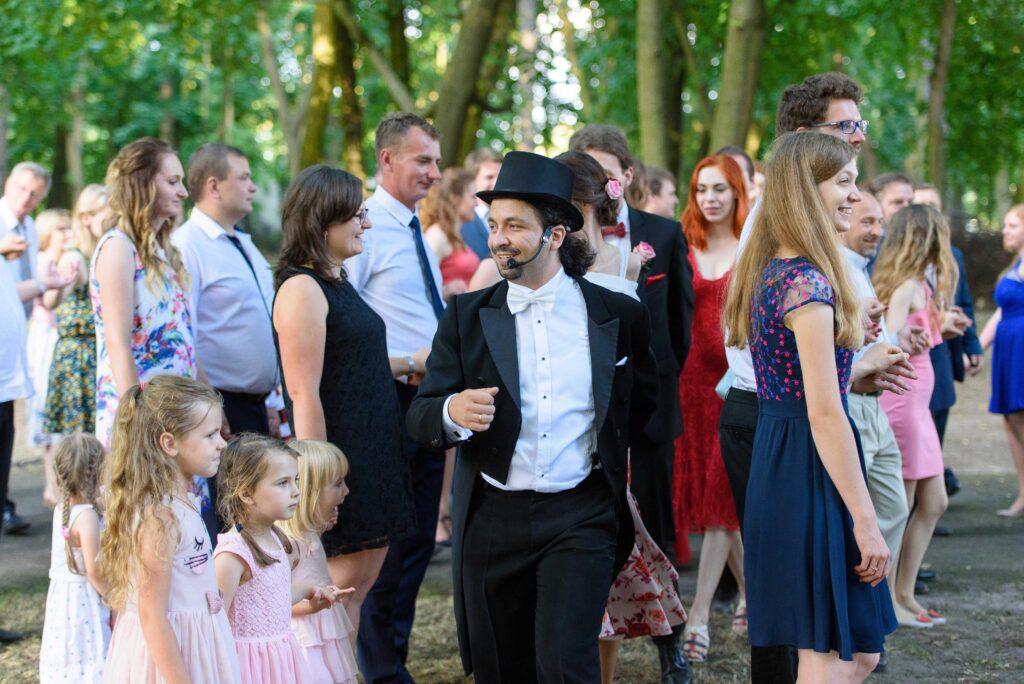
At a Polish wedding the wodzirej runs the whole evening. He decides when things happen, keeps an eye on the room, and changes the plan when something goes wrong, ideally without anyone noticing.
A toastmaster looks after the speeches and a DJ looks after the music. A wodzirej looks after the flow: the pace, the changeovers, and the moment when people stop being polite and start dancing.
At an international wedding there’s one more job: making sure announcements, traditions and jokes reach both sides of the room at once, without the evening turning into a conference with an interpreter.
How it compares
| Role | What they do |
|---|---|
| DJ | Music and announcements |
| Toastmaster | Introduces speeches, manages formalities |
| Wedding planner | Logistics before and on the day |
| Wedding consultant | Advice on suppliers, traditions, decisions |
| Wodzirej | Runs the whole evening: pace, timing, changeovers, both languages. Often covers most of the roles above too. |
Karol also works as a wedding consultant. You can ask him about any part of the day, and he’ll pass on contacts he trusts.
What’s included
Sound, light and the person on the microphone
Karol brings his own sound and lighting, so nothing depends on what the venue happens to have.
♪
Professional sound system
A full PA sized to the venue, whether it’s a small barn or a hotel ballroom. No surprises with the venue’s own equipment.
✦
Lighting & special effects
Dance-floor lighting and a hazer, a light mist that makes the beams visible. The fuller package adds lighting for the whole room and a bubble machine. Used for the right moments, not left running all evening.
◎
MC & hosting
The bilingual programme, traditions, games and everything in between. In English and Polish at the same time.
About the DJ
Karol’s DJ, Rafał, is part of the team, not a separate booking.
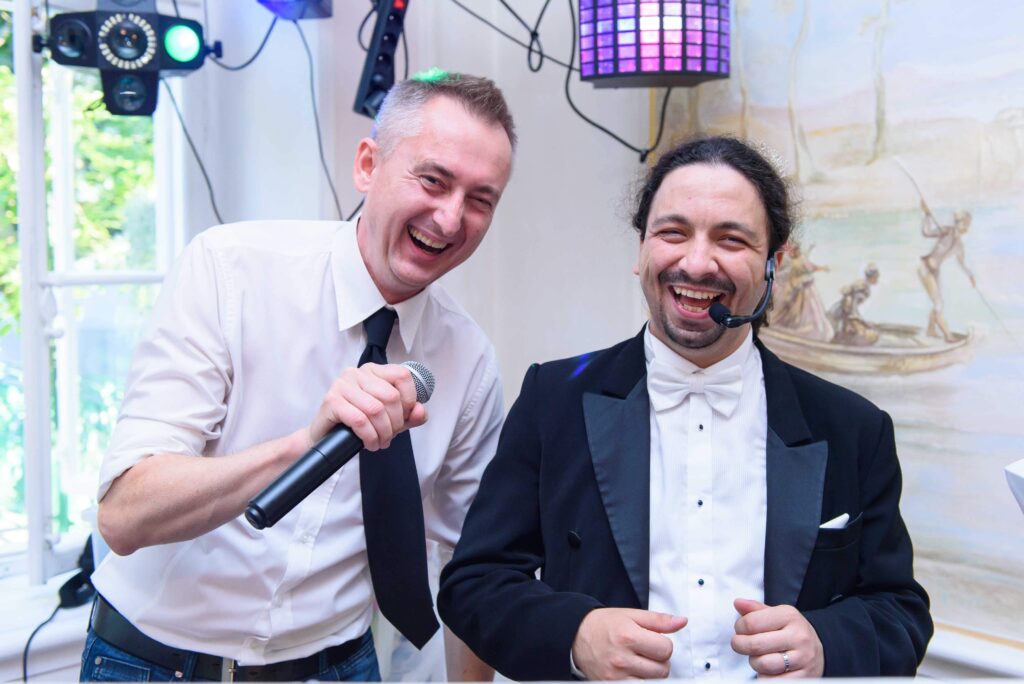
Karol works only with his DJ, Rafał. They’ve done it together for years and barely need to talk during the evening. Because they work as one, the music follows what’s happening in the room instead of a fixed playlist, and Karol can take responsibility for the whole atmosphere, since both the music and the hosting are in his hands.
That said, if you’ve already booked a DJ or have a band you love, Karol is happy to work alongside them. For more on how the sound, lighting and music side of the evening works, see the wedding DJ page.
From first contact to last dance
What happens, and when
meeting
A two-hour conversation, not a sales call
It starts with a video call of around two hours on Google Meet, Teams, Skype or Messenger, whichever suits you. Karol walks you through one of his weddings from start to finish, asks what you’d like, and together you sketch a first outline of the evening. You see what the service involves, and you get to know Karol a little. You’re trusting him with your wedding day, so that part matters. You don’t commit to anything.
before
You’re the directors. Karol is the ideas library.
Karol doesn’t arrive with a template. He brings years of experience from international weddings and shows you the options: traditions you might not have thought of, games that work for a mixed crowd, moments that usually go down well. You decide which of them belong in your wedding. The programme is yours. Karol’s job is to run it smoothly.
before
The checklist and the second meeting
A month before, Karol sends a checklist of the decisions still open, the kind that tend to get left too late. Around the same time you have a second meeting to settle the detailed programme: which games, what happens when, which music.
before
Everything finalised. Your last week is for you.
Every decision, music included, is confirmed at least a week before the wedding. After that, your job is to rest. The planning is done and you can stop thinking about it.
day
Karol arrives hours before the guests do
Before the first guest arrives, the equipment is set up, the venue team is briefed and the timeline is agreed with your photographer and videographer. You don’t need to coordinate any suppliers yourself. When you walk in, everything is ready.
The evening in detail
On the day itself
Arrival & welcome
First, every guest feels at home
Karol greets guests as they arrive and helps with the practical things, like where to leave a coat and where to sit. People need to feel comfortable in an unfamiliar place before anything else. Breaking the ice comes later, once everyone has settled in.
Before every programme point
You’re never surprised by what comes next
Five to ten minutes before any moment that involves you, like a dance or thanking your parents, Karol comes over quietly, tells you what’s about to happen and checks you’re ready. If you need to grab the flowers, find someone or just take a breath, that’s your chance. Nothing starts until you say you’re set.
Speeches & traditions
Every guest understands the moment they’re in
Speeches are introduced in both languages. Polish traditions such as oczepiny, bread and salt or the first dance are explained before they happen, so foreign guests take part instead of watching from the outside.
Throughout the evening
In touch with the venue and your photographer
Karol keeps in touch with the venue, photographer and videographer all evening and adjusts the plan as things change, without involving you. If something unexpected happens, you’ll hear about it the next morning.
Games & entertainment
Polish reception energy, accessible to everyone
Karol adapts games for mixed international crowds, keeping what makes them fun without leaving half the room confused. Nobody is pulled onto the floor against their will.
The dancefloor
When the room is ready, the music knows it
Because Karol and his DJ work as one, the switch from dinner to dancing happens when the room is ready, not when the clock says so.
How Karol works
A few things worth knowing
A few rules Karol sticks to at every wedding.
—
No games with sexual undertones
Not at any wedding, for any crowd. If anyone in the room ends up uncomfortable, the evening hasn’t worked.
—
You always know what’s coming next
A few minutes before anything that involves you, Karol tells you what’s about to happen. The couple never gets caught off guard at their own wedding.
—
Atmosphere, not pressure
Karol invites people in, he never drags anyone. Guests who’d rather watch from the side are as welcome as the ones on the floor.
—
You decide. Karol executes.
There’s no default wedding. Karol brings experience and ideas, you decide what your evening looks like, and he makes it work on the day.
Questions couples ask
Before they say yes
Do you actually translate everything in real time?
Not word for word, or the evening would feel like a UN briefing. What matters is that both sides of the room know what’s going on and feel free to join in. Sometimes that takes a full announcement in both languages, sometimes a quick aside is enough.
We don’t want traditional Polish games. Is that fine?
Completely. The programme is built from your choices. Some couples want every tradition, others want a reception that would feel just as normal in London as in Warsaw. Karol shows you the options. He won’t tell you what your wedding should look like.
What if something goes wrong on the day?
Something always does. A supplier is late, a speech runs long, the weather changes the layout. Karol handles it, and most couples only hear about it the next morning.
We already have a DJ / band booked. Can you still work with us?
Yes. Karol’s own DJ comes as part of the package, which lets him steer the whole evening. But if you’ve already found musicians you love, he’ll work with them and coordinate with them directly on the day.
We’re getting married outside the main cities. Do you travel?
Karol is based in Central Poland and works across the Masovian and Podlaskie regions: Warsaw and the surrounding area, Białystok and Podlasie, and the Łódź area. He also travels to destination weddings further away, abroad included. Get in touch and you can talk through the logistics.
How far in advance should we book?
Popular dates, especially summer Saturdays, go 12 to 18 months ahead. If you have a date in mind, write early, even if everything else is still open. The first conversation commits you to nothing.
The first conversation
is two hours, no commitment,
and completely free.